
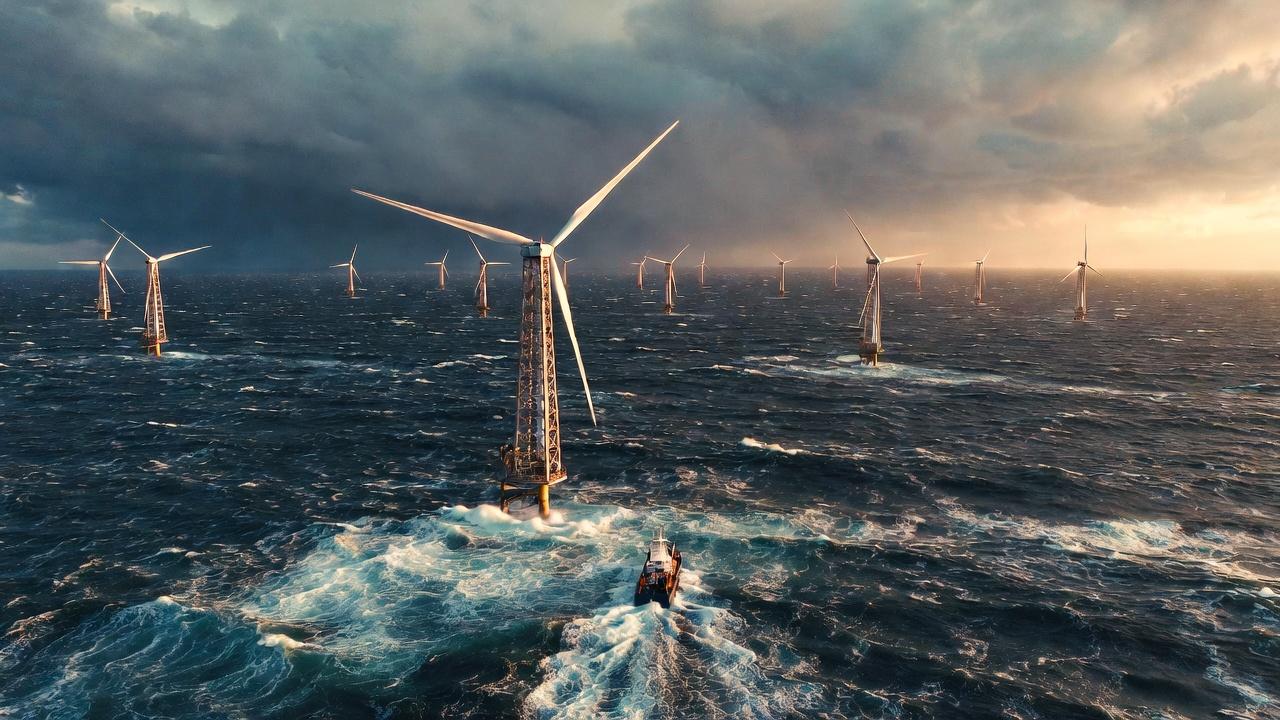
Three major offshore wind projects reached commercial milestones in the same week of March 2026. Revolution Wind began delivering power to New England's grid on March 13. Vineyard Wind 1 completed physical construction. RWE's Thor wind farm, Denmark's largest, fed electricity into the Danish grid for the first time on March 17. The capacity numbers are striking: 704 MW, 800 MW, 1.1 GW, projects that will collectively power millions of homes and reshape regional energy economics.
What the press releases do not cover is the operational complexity that sits behind these commissioning announcements. Offshore wind is not a build-and-forget asset class. It is a 25-year operational commitment to managing infrastructure in one of the most demanding environments on earth, with crews, vessels, weather windows, and subsea assets that all require coordinated, real-time intelligence to manage safely and profitably.
The technology stack serving those operational needs has not kept pace with the capacity growth.
What Running an Offshore Wind Farm Actually Requires
The public conversation about offshore wind focuses almost entirely on installation milestones and megawatt counts. The operational reality is more granular and more demanding.
An offshore wind farm in active generation requires continuous monitoring of turbine health across potentially hundreds of units. It requires service operations vessels and crew transfer vessels moving personnel to and from turbines in conditions that are at best uncomfortable and at worst dangerous. It requires weather window planning that accounts not just for current conditions but for the 12-to-72-hour forecast accuracy that determines whether a maintenance crew can safely reach and return from a turbine. It requires precise cargo logistics to stage the right components at the right time so that maintenance windows are not lost waiting for a part that should have been pre-positioned.
When one of these elements fails, the cost is not linear. A missed weather window means a delayed repair. A delayed repair on a turbine in a high-wind period means lost generation revenue. A crew mobilization error that puts the wrong certified personnel on a vessel means a maintenance task cannot be completed even after the crew arrives. These compounding failures are not hypothetical. They are operational realities that wind farm operators deal with every time their planning tools do not integrate.
The Vessel Charging Problem Is Bigger Than It Looks
Stillstrom, the A.P. Moller-Maersk subsidiary focused on offshore vessel charging, established a dedicated UK entity in March 2026 with plans for commercial rollout of charging infrastructure for service operations vessels. The announcement was framed primarily as a decarbonization initiative. But the underlying problem it is solving reveals something structural about how offshore wind operations currently work.
SOVs are among the most energy-intensive vessels in the offshore sector. They operate continuously during offshore campaigns, serving as floating hotels and maintenance bases for technicians working on turbines. Their fuel consumption is significant and their operational costs are high. Decarbonizing them requires charging infrastructure that does not yet exist at the scale the expanding offshore wind sector requires.
This is one example of a broader pattern: the operational infrastructure supporting offshore wind, vessels, logistics, weather intelligence, personnel management, is being built out reactively, following project commissioning rather than anticipating it. The result is operational gaps that translate directly into higher maintenance costs and lower availability rates during the first years of project life, when developer revenue is most sensitive to underperformance.
Weather Intelligence Is the Underappreciated Bottleneck
Offshore wind operations are more weather-dependent than any other form of energy infrastructure. Fixed-bottom turbines can be accessed only within defined sea state and wind speed thresholds. Floating offshore wind, being developed on the US West Coast and in deep European waters, adds motion dynamics to those thresholds. Helicopter transfers to platforms in the same operational area have their own separate envelope.
The precision required here is not the kind that a standard weather forecast delivers. An offshore operations team planning a 48-hour maintenance campaign needs hyperlocal forecasting at the specific site, calibrated to the access thresholds of their specific vessel and crew transfer method, with automated alerts if conditions deteriorate during the window.
Current practice across much of the industry involves a combination of commercial weather services, operator experience, and conservative safety buffers that cost availability. The integration of precision forecasting directly into operational scheduling, where the weather model is connected to crew mobilization, vessel dispatch, and cargo pre-positioning, is not yet standard across the sector.
The UK government's March 2026 announcement of new radar systems designed to unlock 10 GW of additional offshore wind capacity points to a related issue: wind farms currently create radar interference that constrains air defense operations. The radar mitigation systems will not be operational until 2029. For the operations teams managing assets between now and then, this is one more coordination variable that requires active management rather than passive monitoring.
Drone Logistics and the Next Frontier of O&M
Volatus Aerospace secured a contract in March 2026 to develop heavy-lift drone logistics for offshore wind operations and maintenance, focused on delivering payloads up to 100 kg to offshore turbines in maritime environments. The commercial deployment timeline is still being defined, but the contract signals where the industry expects the O&M logistics model to evolve.
If drones can reliably deliver tools, components, and small cargo to individual turbines without requiring a vessel transfer, the economics of routine maintenance change substantially. Turbines that currently require a vessel mobilization for minor inspections or component swaps could be serviced with a fraction of the current logistical cost. The weather window requirements for a drone delivery are also different, and potentially wider, than those for crew transfer operations.
What Integrated Operational Intelligence Looks Like
The offshore wind operators generating the best availability rates in 2026 share a common characteristic. They have moved toward integrated operational platforms where fleet tracking, crew management, weather intelligence, and supply chain logistics operate from a shared data layer rather than in parallel silos.
When weather intelligence feeds directly into crew rotation scheduling, a deteriorating forecast triggers automatic review of planned transfers before a crew has mobilized. When cargo logistics is connected to maintenance planning, the system flags when a required component has not been pre-positioned for an upcoming window. When vessel tracking is integrated with personnel records, the platform can verify that crew members on an inbound vessel hold the certifications required for the work they are dispatched to perform.
Each of these integrations sounds incremental. Collectively they represent a step change in how offshore operations are managed, from reactive coordination across disconnected tools to proactive operational intelligence that surfaces issues before they become incidents.
The offshore wind sector is in the early stages of this shift. The capacity growth happening now, Revolution Wind, Thor, Coastal Virginia, the pipeline of projects behind them, will generate the operational scale that makes integrated intelligence infrastructure economically essential. The operators building those capabilities now will have a material cost and availability advantage over those who try to retrofit them later.